

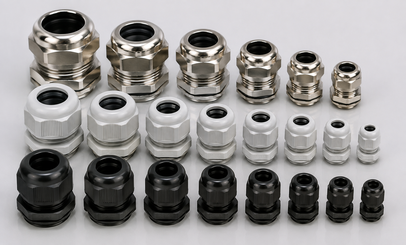
NexGen Engineering & Industrial Solutions provides reliable Cable Glands designed for secure cable entry, termination, and mechanical protection in electrical and industrial installations. Our cable glands help maintain a safe and organized connection between cables and electrical enclosures while providing effective strain relief and protection against environmental conditions.
Available in suitable materials, sizes, and configurations, our Cable Glands can be selected according to cable type, enclosure requirements, installation environment, and specific project applications. They provide a secure grip around the cable while helping prevent the entry of dust, moisture, and other external elements into electrical equipment when used with an appropriate protection arrangement.
Suitable for electrical panels, junction boxes, control panels, instrumentation systems, industrial machinery, cable termination applications, and infrastructure projects, NexGen Cable Glands support safe, reliable, and professionally organized electrical installations with dependable performance and long-term serviceability.
Cable Glands are used to securely introduce and terminate cables into electrical enclosures while providing mechanical support, strain relief, and protection around the cable entry point.
A Cable Gland helps secure a cable at the enclosure entry point, provides strain relief, and helps protect the connection against dust, moisture, and other environmental factors when the appropriate gland and protection level are selected.
Yes, Cable Glands are available in different sizes, materials, thread types, and configurations to accommodate different cable diameters, enclosure requirements, and installation conditions.
Cable Glands are commonly used in electrical panels, junction boxes, control panels, instrumentation systems, industrial machinery, power installations, and various industrial and infrastructure applications.
The appropriate Cable Gland should be selected based on cable diameter, cable construction, enclosure entry thread, installation environment, required protection level, material compatibility, and specific application requirements.
Connect with us for reliable support and quick solutions.